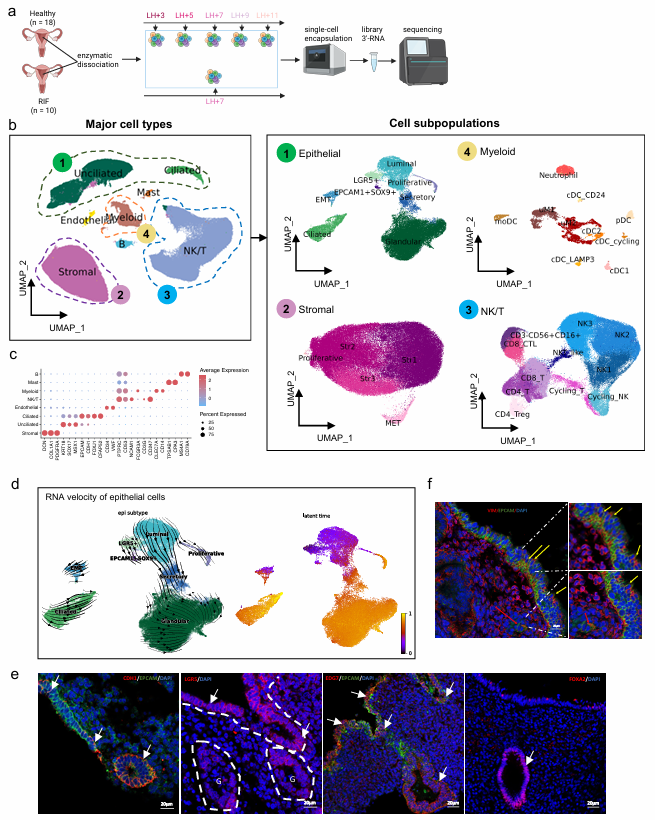
Dr. Yijun Liu of the School of Artificial Intelligence has proposed a deep learning framework for analyzing single-cell omics data of the human female endometrium, decoding endometrial dynamics during the implantation window in pregnant women and characterizing endometrial defects in women with recurrent implantation failure. The results were published in the premier international journalNature Communicationsunder the title "Time-series single-cell transcriptomic profiling of luteal-phase endometrium uncovers dynamic characteristics and its dysregulation in recurrent implantation failures."
Time-series single-cell transcriptomic profiling of luteal-phase endometrium uncovers dynamic characteristics and its dysregulation in recurrent implantation failures
First author: Yijun Liu
Supervising faculty: Prof. Yi Chang
Journal:Nature Communications
Overview
Understanding the dynamics of the human endometrium in establishing endometrial receptivity remains a challenge, which limits the early diagnosis and treatment of endometrial-factor infertility. By constructing a deep learning model for temporal prediction and expression pattern discovery, we analyzed and modeled single-cell transcriptomic data from more than 220,000 endometrial cells, decoding endometrial dynamics during the implantation window in pregnant women and characterizing endometrial defects in women with recurrent implantation failure. The time-series atlas highlights a two-stage decidualization process of stromal cells and a gradual transition of luminal epithelial cells. In addition, we identified a time-varying gene set that regulates epithelial receptivity, and on this basis classified the endometrium of women with recurrent implantation failure into two categories of defects. Further investigation revealed a hyperinflammatory microenvironment in the dysfunctional endometrial epithelial cells of recurrent implantation failure. This work was completed under the supervision of Prof. Yi Chang, in collaboration with Research Fellow Dandan Cao of The University of Hong Kong–Shenzhen Hospital and Prof. Yuanhua Huang of The University of Hong Kong.