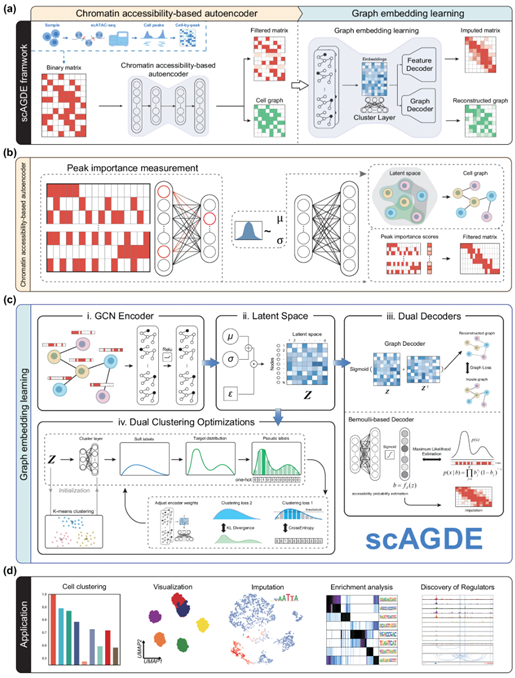
Gaoyang Hao, a PhD student of the 2024 cohort supervised by Prof. Xiangtao Li, has proposed a graph deep learning framework for single-cell chromatin accessibility data analysis. By explicitly modeling the data generation process, the method learns representations and performs clustering simultaneously, and effectively reveals key regulatory elements associated with cell identity as well as the functional diversity of single cells. The results were published in the premier international journalNature Communicationsunder the title "Topological identification and interpretation for single-cell epigenetic regulation elucidation in multi-tasks using scAGDE."
Gaoyang Hao joined the School of Artificial Intelligence in 2022 to pursue a master's degree under the supervision of Prof. Xiangtao Li, and in 2024 was admitted through the combined master's–doctoral program to pursue a doctoral degree, also under Prof. Xiangtao Li. He currently works on single-cell and spatial omics data research.
Gene expression is regulated by millions of active DNA regulatory elements exposed in accessible chromatin regions of the genome. Single-cell assay for transposase-accessible chromatin sequencing (scATAC-seq) probes the chromatin accessibility landscape using the hyperactive Tn5 transposase. By profiling chromatin accessibility, scATAC-seq therefore provides insights into cellular heterogeneity beyond transcriptomic measurements, revealing epigenetic regulatory mechanisms at the single-cell level. In genome-wide analysis, however, the capture rate of open chromatin sites is relatively low, resulting in the high dimensionality and sparsity of scATAC-seq data, which poses substantial challenges for analysis. Such sparsity masks important genomic information and complicates downstream analyses such as peak calling and motif discovery. In addition, the inherent constraints of DNA copy number exacerbate the binary nature of the data, making signal and noise difficult to distinguish. To address these issues, this study proposes scAGDE. Experimental results show that scAGDE outperforms existing methods in cell separation and visualization, alleviates the dropout problem, and reveals potential chromatin accessible regions. When applied to human brain tissue, scAGDE successfully annotated cell types determined by cis-regulatory elements and revealed the functional diversity and regulatory mechanisms of glutamatergic neurons.
Link:https://www.nature.com/articles/s41467-025-57027-x#Abs1