Organized by the International Federation of Automatic Control (IFAC), the IFAC World Congress is a premier international academic conference in the field of automatic control and a Category A conference of the Chinese Association of Automation (CAA). Held once every three years, it is the most influential comprehensive academic event in control science and engineering worldwide. IFAC 2026 will take place from August 23 to 28, 2026 in Busan, South Korea. Two papers by faculty and students of the School of Artificial Intelligence, Jilin University have been accepted by the congress.
A Gauss-Newton-Induced Structure-Exploiting Algorithm for Differentiable Optimal Control
First author: Yuankun Chen (Master's student, 2024 cohort)
Corresponding author: Zifei Nie
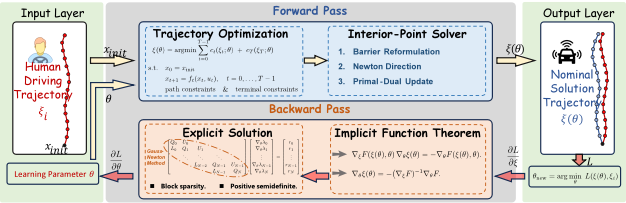
Differentiable optimization embeds parameterized optimization problems into neural networks as optimization layers, enabling end-to-end learning while ensuring decision safety, interpretability and structural consistency. Compared with conventional neural network layers, however, its forward solution and backward gradient propagation generally incur higher computational costs, posing a significant efficiency bottleneck in practical applications. To address this issue, this paper departs from existing indirect solution approaches based on equivalent auxiliary systems, and instead directly analyzes and exploits the matrix structure of the differential KKT system. Under a Gauss-Newton approximation, and by further exploiting the block-sparse structure and positive semidefiniteness of the Hessian matrix, the method transforms computationally intensive large-scale general matrix factorizations into a series of small-scale, highly efficient factorization computations, achieving a theoretical reduction of approximately 50% in computational complexity. Experimental results show that the proposed method delivers an average speedup of 180% over baseline methods on synthetic datasets, and its practicality and effectiveness are further validated in an imitation learning task based on real driving demonstrations.
Event-Triggered Reference Governor with Deep Reinforcement Learning for Constrained Quadrotor UAV Control
First author: Rong Wang (PhD student, 2022 cohort)
Corresponding author: Xun Gong
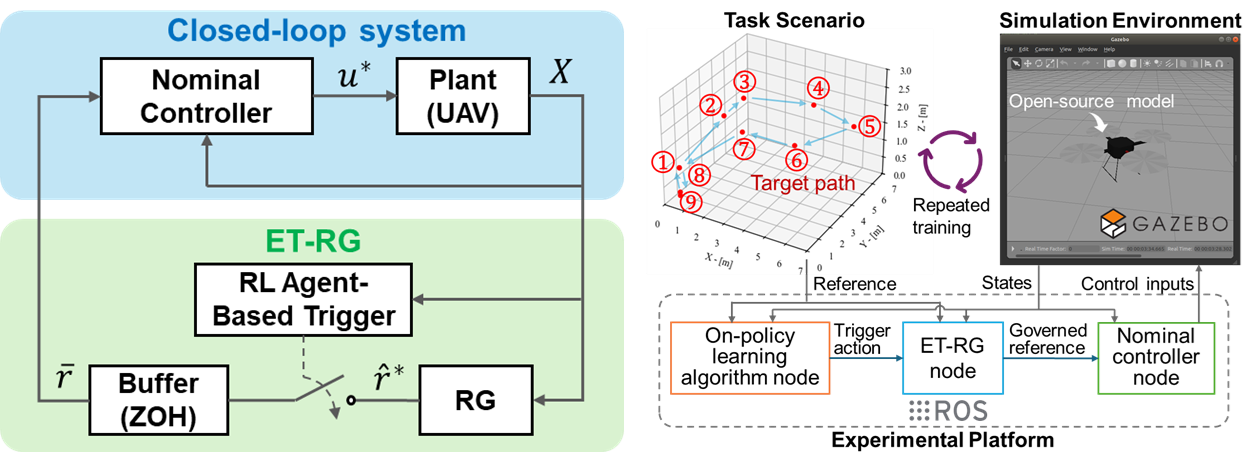
To address state constraints during quadrotor UAV flight, this study proposes an event-triggered reference governor approach for constrained control. Building on an existing linear-feedback UAV control system, the method introduces an add-on reference governor that appropriately adjusts the reference trajectory fed into the control system, thereby ensuring that the UAV's motion states always satisfy predefined constraints. To strike a balance between computational cost and control performance, the study further introduces an event-triggering model based on reinforcement learning, whose triggering policy is learned online in the Gazebo simulation environment. Guided by the UAV's real-time flight state, this policy reduces the frequency of activating the reference governor at unnecessary moments, thereby effectively cutting the number of receding-horizon optimization calls and significantly alleviating the system's computational burden.