A research achievement by Yili Wang, a PhD student of the 2021 cohort at the School of Artificial Intelligence, on contrastive learning strategies for topological bias in large-scale graphs, has been accepted byIEEE Transactions on Pattern Analysis and Machine Intelligence(TPAMI, IF=20.5), a premier international journal in the field of artificial intelligence. As one of the most influential journals in artificial intelligence, TPAMI enjoys a high reputation in the global academic community.
AdaGCL+: An Adaptive Subgraph Contrastive Learning Towards Tackling Topological Bias
First author: Yili Wang (PhD student, 2021 cohort)
Supervising faculty: Assoc. Prof. Xin Wang
Journal:IEEE Transactions on Pattern Analysis and Machine Intelligence
Journal category: CCF-A
Overview
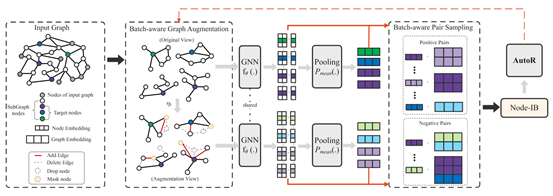
In the training of graph neural networks (GNNs) on large-scale graphs, the commonly used batch sampling method alleviates pressure on computational resources, but inevitably introduces topological bias, causing subgraphs to miss critical node features or edge structures and thereby impairing the model's generalization ability. To address this issue, we propose an adaptive subgraph contrastive learning framework, AdaGCL+, which significantly improves model performance while maintaining training scalability. AdaGCL+ dynamically performs graph augmentation according to each sampled subgraph and introduces a subgraph-level contrastive learning objective, keeping node representations consistent across different augmented views and thus improving robustness to incomplete structures. To further optimize the augmentation strategy, AdaGCL+ introduces a node-based information bottleneck mechanism (Node-IB) that adaptively controls the balance between similarity and diversity between the original and augmented graphs. By dynamically adjusting perturbation parameters (such as the edge deletion rate), Node-IB can automatically optimize the graph augmentation process according to downstream task performance. On multiple benchmark datasets, AdaGCL+ outperforms existing state-of-the-art methods in both node classification accuracy and training efficiency, demonstrating strong generalization ability and practical application potential.