Under the supervision of Prof. Xiangtao Li, Yi Fan, a PhD student of the 2021 cohort at the School of Artificial Intelligence, Jilin University, has made important progress in single-cell multi-omics data integration and proposed a new integration method, OmiDos. Starting from the perspective of "signal disentanglement," the method provides a new computational framework for the joint analysis of regulatory networks in complex biological systems. Unlike conventional approaches that directly compress information from different modalities into a unified latent space, OmiDos explicitly distinguishes and learns two types of representations: one characterizing omics-specific features, and the other capturing coordinated regulatory information across omics. Through this "orthogonal disentanglement" design, the model preserves the unique information of each omics layer while more accurately extracting biologically meaningful shared regulatory programs. The results were published in the international academic journalProceedings of the National Academy of Sciences(PNAS), under the title "Orthogonal disentanglement of single-cell multi-omics reveals private and shared drivers of tissue development and pathogenesis."
Yi Fan is a PhD student of the 2021 cohort at the School of Artificial Intelligence, Jilin University. His research focuses on deep unsupervised learning methods for single-cell multi-omics data integration and clustering, and explores their application in the study of cell development and disease mechanisms. He has conducted systematic research on gene regulation, multi-omics integration and related problems, with results published in journals including PNAS,Advanced ScienceandBioinformatics.
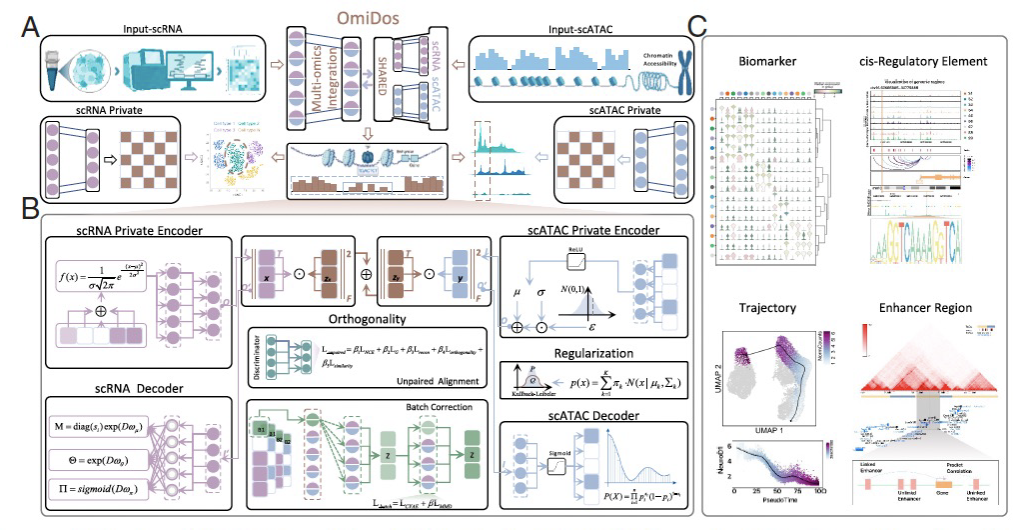
Characterizing the gene expression and regulatory dynamics that underlie normal tissue function and disease progression requires integrated analysis of single-cell multi-omics data. The asynchrony of gene regulation, together with the transient snapshot nature of single-cell multi-omics data, however, gives rise to independent signals specific to each omics layer, as well as shared signals that reflect cross-modal coordination. This study proposes a domain adaptation-based omics separation modeling method (OmiDos), an annotation-free, flexible and general-purpose deep learning framework that disentangles omics-specific and cross-omics shared latent variables in multi-omics data through independent–shared component analysis. Its modular architecture supports seamless extension: adversarial learning can be introduced to address the misalignment of unpaired data, and maximum mean discrepancy (MMD) regularization is applied through a reconstruction component, thereby minimizing disturbance to biological heterogeneity. With this disentanglement mechanism, OmiDos can resolve gene expression and regulatory dynamics at a finer biological scale and supports a variety of downstream analyses. The superior performance of OmiDos in clustering accuracy, batch effect correction and data misalignment correction was validated on multiple datasets spanning different platforms and tissue types. In a study of mouse secondary palate development, OmiDos precisely identified a cell-type-specific non-linked distal enhancer and clarified its key role in regulating epithelial cell differentiation and migration. Applying OmiDos to medulloblastoma research revealed a potential regulatory function defect during the partial closing of the distal enhancer region of theNeurod1gene, which may be an important driver of the progression of medulloblastoma from a normal to a tumorous state.
Link:https://www.pnas.org/doi/10.1073/pnas.2519870123